

How to Cope with Headaches?
Headaches are a common neurological disease that almost everyone encounters, second only to the prevalence of colds. Even colds can cause symptoms such as headaches. How should we deal with common headaches?
Sharing Doctor Introduction

Dr. Chenqi ZHANG
Neurologist
Dr. Chenqi ZHANG is a skilled neurologist with over five years of expertise in the field. Having graduated with distinction from Southwest Medical University, she has dedicated her career to advancing the understanding and treatment of neurological disorders.
Specializing in headaches, mood disorders and epilepsy etc., Dr. ZHANG has conducted over ten academic papers, including six SCI-indexed publications, and invented one medical-related patent. Her expertise has been recognized internationally.
Prior to her current position as a senior neurologist at the Chengdu BOE Hospital, Dr. ZHANG completed her residency and fellowship training at Sichuan provincial People’s Hospital for three years, a nationally renowned medical institution. During this time, she honed her clinical skills and developed a passion for patient-centered care.
Dr. ZHANG is committed to staying at the forefront of medical advancements and continuously seeks out new therapies and treatments to improve patient outcomes. She believes in the power of collaboration and works closely with a multidisciplinary team to provide comprehensive care for her patients. She is also an avid reader and keeps up-to date with the latest medical literature.
Why Do I Have a Headache?
There are various causes of headaches, numbering over a hundred. Headaches can be caused by organ dysfunction or simply by nerve dysfunction. Therefore, in medicine, headaches can be divided into two main categories based on whether a clear cause can be identified: primary headaches and secondary headaches. The first category is primary headaches, which refer to headaches where a specific cause cannot be found. Common primary headaches include migraine, tension headache, cluster headache, and trigeminal neuralgia, accounting for a significant proportion of headaches in daily life. The other category is secondary headaches, which refer to headaches where a specific cause can be identified. These include headaches caused by intracranial lesions, such as subarachnoid hemorrhage, hypertensive cerebral hemorrhage, and cavernous sinus thrombosis; headaches caused by extra cranial lesions, such as otitis media, glaucoma, and oral diseases; or headaches caused by systemic diseases, such as hypertension and colds.
How to Quickly Identify My Headache?
The symptoms and locations of certain headaches are quite typical, so we can identify them based on different locations.
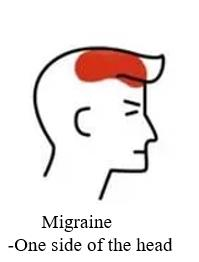
Migraine
Often occurs on one side of the head, with unilateral, pulsating, or throbbing pain, often lasting 4-72 hours. During an attack, it can be accompanied by photophobia, nausea, vomiting, and other discomforts. Some patients may have blurred vision. In some female patients, migraine may have a clear relationship with menstruation.
Tension headache
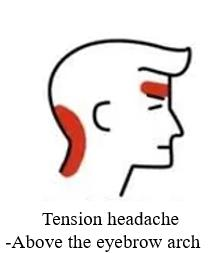
The pain area is mostly above the bilateral eyebrows, the neck, and the bilateral occipital area. It often occurs after emotional stress, excitement, fatigue, or staying up late. It feels like wearing a hat on top of the head, often manifesting as dull pain, with a sense of oppression, tightness, and constriction. It can also feel heavy shoulders.
Cervicogenic headache
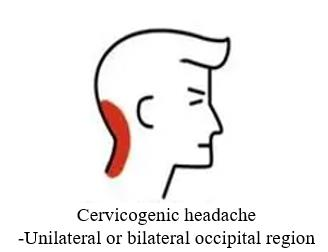
Manifests as unilateral or bilateral occipital and post-auricular dull pain or soreness, which may be accompanied by nausea, vomiting, tinnitus, and eye distension. It often occurs in people who have long-term low head posture or muscle strain for a long time.
Cluster headache
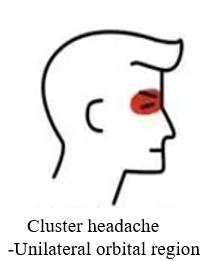
Mostly severe unilateral headache with acute onset, which can recur. The pain location is on the unilateral orbital, supraorbital, retro bulbar, and temporal areas, manifesting as sharp, explosive, severe, or concentrated pain.
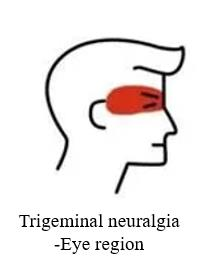
Trigeminal neuralgia
Often occurs in the ocular region, the ophthalmic branch area of the trigeminal nerve, manifesting as stabbing pain, burning sensation, throbbing pain, electric shock pain, and tearing pain.
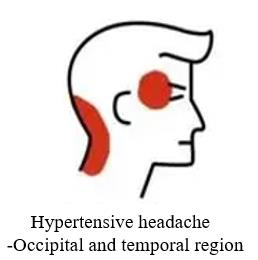
Hypertensive headache
The pain is mostly concentrated in the occipital and temporal areas, sometimes feeling heavy and oppressive. It can be accompanied by symptoms such as dizziness and nausea.
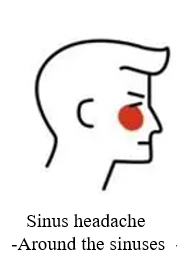
Sinus headache
The pain area is around the sinuses, including the cheekbones, forehead, and nose bridge, which can be accompanied by symptoms such as nasal discharge, ear fullness, facial swelling, and fever.
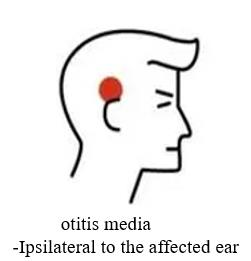
Headache caused by otitis media
Often occurs on the same side as the affected ear, with intense pain that can even cause ipsilateral migraine. It is often accompanied by ear discharge and fever.
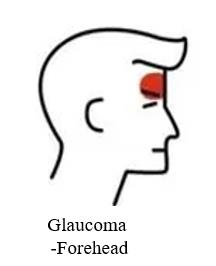
Glaucoma headache
The pain is mostly located in the forehead, temporal area, and around the orbital area, which can be accompanied by reflex nausea and vomiting.
What Measures Can I Take When a Headache Occurs?
The causes of headaches are complex. If you know the triggers, try to avoid them as much as possible. If avoidance is not possible, occasional primary headaches can be relieved with appropriate pain relievers or massage under the guidance of a doctor. However, it is worth noting that in cases where the cause is unknown, enduring the pain may worsen the symptoms and immediate medical attention is needed.
01 Take pain relievers appropriately: Patients with occasional headaches can purchase over-the-counter drugs such as ibuprofen and voltaren. They can be taken for 3-5 days, but avoid long-term and empty stomach use. If the patient has frequent headaches that affect daily life or if they occur around a certain time, such as during menstruation, preventive medication can be given, such as calcium channel blockers like flunarizine hydrochloride tables or beta-blockers. However, all medications have side effects, so it is important to use them reasonably under the guidance of a doctor.
02 Seek a quiet environment for rest: For patients with tension or migraine, they may be sensitive to sound and light. Resting in a dark room can help relax the body and improve headache symptoms.
03 Applying heat or ice: Wrap a hot water bag or ice pack in a towel and place it on the forehead or painful area to relieve headache symptoms.
04 Acupressure massage: For tension headaches, gently massage the corresponding painful area with your fingers, rest for a few seconds, and repeat multiple times to improve blood circulation in the head and relieve headache symptoms.
05 Lifestyle adjustment: Reduce stimulant foods that are prone to trigger pain, such as chocolate, alcohol, coffee, and strong tea; avoid prolonged sleep deprivation or overexertion, maintain sufficient sleep time (6-8 hours); choose a comfortable sleeping position and pillow height to ensure the normal physiological curvature of the cervical spine.
Which Headaches Require Immediate Medical Attention?
However, if your headache is accompanied by the following symptoms, please go to hospital immediately for professional consultation:
1. Fever
2. Mental impairment, confusion, difficulty communicating
3. Sudden fainting
4. Numbness or sensory abnormalities in one limb
5. Limb weakness, inability to walk normally
6. Neck stiffness, inability to nod
7. Decreased vision, inability to see clearly
8. Speech difficulties
9. Severe nausea or vomiting
10. Self-perception of the worst headache in life or a sudden severe headache
11. Sudden increase in severity or frequency of chronic headaches
成都京东方医院是由京东方科技集团投资建设的集医疗、教学、科研、预防、保健、康复为一体的现代化大型三级综合医院。
医院坐落在成都天府国际生物城,占地354亩,一期投资60亿元,设置床位 2000 张,建筑面积38.5万平方米,配备有全数字化PET/CT、SPECT/CT、医用直线加速器、双源CT、3.0T 及1.5TMRI、术中CT、DSA、骨科G型臂X线机等高精尖设备,配备大型方形高压氧仓群,拥有杂交手术室、高水平大规模无菌层流病房。
医院是电子科技大学医学院首家教学医院、成都医学院教学医院,与首都医科大学附属北京安贞医院合作共建了“国家心血管病临床医学研究中心地区合作中心”,先后被授予“四川省医院协会副会长单位”、“四川省红十字会团体会员单位”、“第五届‘中国十佳医院建筑设计方案’奖”、“成都市退役军人事务局共建共享退役军人服务超市合作单位”、“成都市卫健委疫情防控先进集体”等荣誉称号。

Chengdu BOE Hospital is a modern large-scale tertiary comprehensive hospital invested and constructed by BOE Technology Group, integrating medical treatment, teaching, scientific research, prevention, health care, and rehabilitation.
The hospital is located in Chengdu Tianfu International Biological City, covering an area of 354 acres with a first phase investment of 6 billion yuan. It has 2000 beds and a construction area of 385000 square meters. It is equipped with high-precision and cutting-edge equipment such as fully digital PET/CT, SPECT/CT, medical linear accelerator, dual source CT, 3.0T and 1.5T MRI, intraoperative CT, DSA, orthopedic G-arm X-ray machine, and is equipped with a large square high-pressure oxygen chamber group. It also has hybrid operating rooms and high-level large-scale sterile laminar flow wards.

The hospital is the first teaching hospital of the School of Medicine at the University of Electronic Science and Technology of China and the teaching hospital of Chengdu Medical College. It has collaborated with Beijing Anzhen Hospital affiliated with Capital Medical University to jointly establish the “Regional Cooperation Center of the National Cardiovascular Disease Clinical Medical Research Center”. It has been awarded honorary titles such as “Vice President Unit of Sichuan Hospital Association”, “Member Unit of Sichuan Red Cross Society Group”, “5th China Top 10 Hospital Architectural Design Plan Award”, “Collaborative Unit of Chengdu Veterans Affairs Bureau in Building and Sharing Veterans Service Supermarket”, and “Advanced Collective of Chengdu Health Commission in Epidemic Prevention and Control”.